
Hello there, and welcome to my little blog exhibit on photographing butterflies, a soothing niche of wildlife photography! If you’d like, here’s a brief summary of camera settings and the impact they have on captured shots:
- Shutter Speed: This can either freeze movement or allow motion blur; wildlife photography typically needs a “fast” shutter speed (such as 1/1000 of a second) to capture animals in action properly.
- Aperture: Also referred to as “f-stops”, this determines how much of the entire scene is in focus; f/9 is considered a “narrower” aperture that puts the background in slightly more focus than is often preferred by wildlife photographers, compared to “wider” apertures such as f/5.6.
- ISO: This affects your image’s overall brightness/exposure and quality; too much ISO results in a softer, diminished photo, while too little makes everything undesirably dark.
- Another note on ISO: When photographers first start taking shots, they may sacrifice their shutter speed and aperture to keep the ISO as low as possible. This is a common mistake and a simultaneous lesson for beginner photographers: a somewhat higher ISO is our friend, not an enemy to be mistrusted.
Throughout this blog post, you’ll see me describe my camera settings for my butterfly photos in the following format: shutter speed (a fraction of a second), aperture (marked as f/#), and ISO (such as ISO 800).
The Importance of Settings
My ongoing photography goal throughout 2025 has been to let myself use different camera settings than what I stuck with last year. For example, in 2024, I fervently believed that the combination 1/640, f/8, Auto ISO would always yield the best results for most of my nature shots.
While it did give me some great photos, the lack of mental flexibility regarding camera settings temporarily inhibited my growth as a photographer. Conversely, allowing myself to play around with different levels of shutter speed and apertures has helped me grow exponentially!
Tinkering in manual mode, which lets me fully control each setting, has also helped me improve my photography. Despite my initial concerns about image quality, raising my maximum ISO to 6400 has been vital for making my best shots possible. In many cases, ISO 400 is utterly ineffective!
Choosing a Narrow Aperture for Sunlit Butterflies
I’m currently using a Canon EOS REBEL T3i DSLR and Canon EF 70-300mm f/4-5.6 IS II USM telephoto lens for my butterfly shots. It’s been a tricky combo, at times! My lens won’t focus properly if I get too close to my subject, and unfortunately, my T3i lacks the focus tracking capabilities of more recent camera models.
But they flourish when they work together and capture the subject in detail!
I believe f/9 is the “sweet spot” aperture for my lens/camera combo, at least when the subject is in great lighting. F/9 gives my subject plenty of detail while keeping the background in perfect focus (without it becoming a blown-out distraction).
Over the last week or so, I’ve been using f/9 when capturing butterflies in bright sunlight. I love how these came out! The best part has been seeing the incredibly sharp detail on their wings.
Here are some of my favorites!
Clouded Sulphur Butterflies
It’s late September, which means that goldenrod (and its unrelated look-alike, flat-topped goldenrod) is flourishing across our neighborhood! This lovely wildflower is popular with many pollinators, including clouded sulphur butterflies.
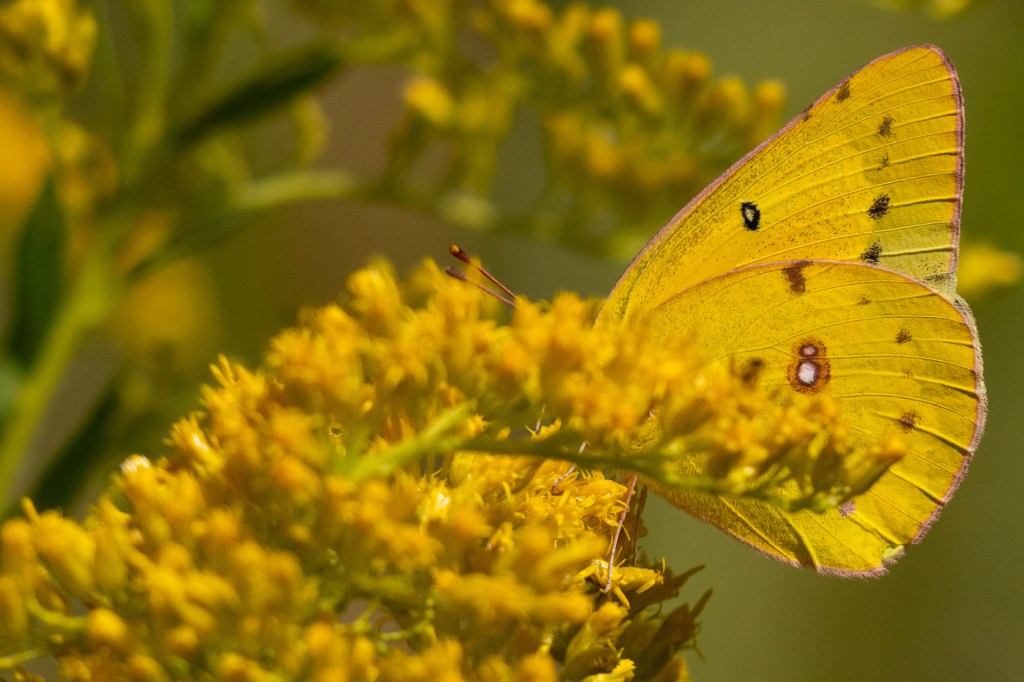
I’m stunned by the level of detail on the wings. I’m also grateful that my camera properly focused here instead of making the goldenrod the subject!
The butterfly’s head being hidden behind the flowers helped make the wings stand out with a surprising level of clarity.
My Canon EF 70-300mm lens continues to impress me with how sharp it makes my subjects look. The only downside to this lens is its minimal focusing distance. Because I can’t get too close to the butterflies, I have to do some heavy cropping when editing.
While that’s unfortunate, it’s a fair trade for getting a shot like this!
Cabbage White Butterflies
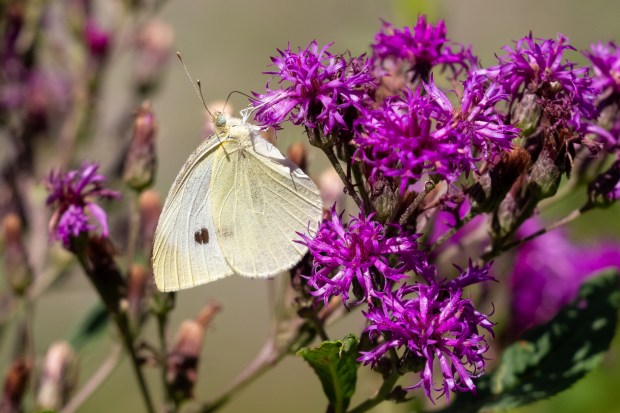
Cabbage white butterflies are a constant visitor in our neighborhood. They prefer flat-topped goldenrod and purple ironweed flowers, especially ironweed!
One lucky September day, I saw one enjoying our butterfly flowers in the backyard. I’m so thankful that I had my camera ready for this moment!
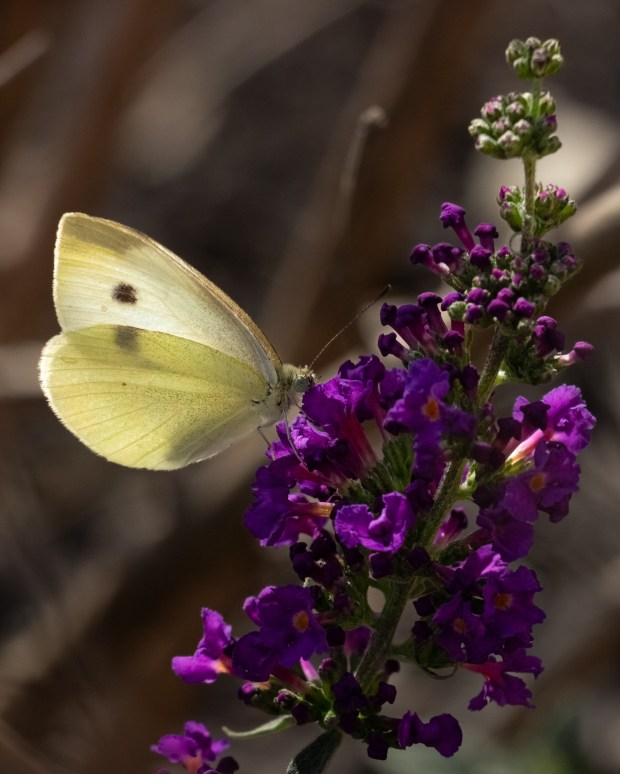
While I generally try to avoid raising the ISO level if possible, this was a time when it was inevitable. Cabbage whites are delightfully impatient, only lingering for a few seconds on a flower before flitting away to their next destination.
A wider aperture (such as f/8 or f/7.1) might have been a better choice for this shot. The branches do stand out in the background. However, f/9 guaranteed that the flowers were in decent focus!
This shot, including the composition, involved a tremendous amount of sheer luck. I struggle with deliberately composing my wildlife shots in the moment’s pressure to get the picture. Thankfully, the butterfly flowers weren’t cropped out of the way!
I’ve been observing the cabbage whites for a while now, and they seem to lack proper manners in how they act towards other butterflies. When I took this photo, I was enjoying the company of a Zabulon skipper butterfly inspecting the purple flowers. Neither of us expected this cabbage white to suddenly fly in and make the Zabulon move out of the way!
Here’s a bonus shot of a cabbage white inspecting ironweed flowers:
Eastern Comma Butterflies
I’ve had the pleasure of coming across Eastern comma butterflies during my trips to Inniswood and Highbanks, my two favorite parks where I live! They act utterly unafraid of people, willing to approach me with an impressive level of boldness.
They might also know how epic they look when in the proper lighting!
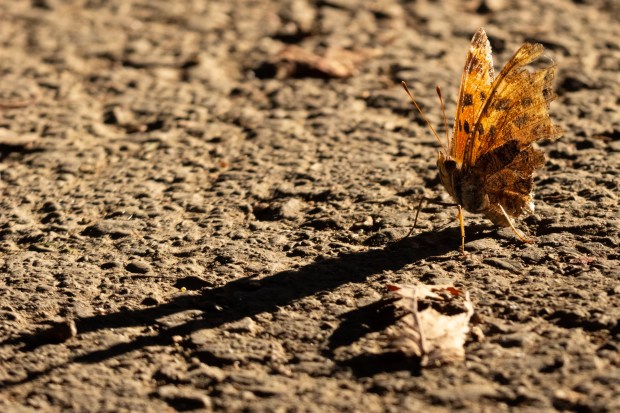
I took this picture during my most recent trip to Highbanks this month. This Eastern comma saw me walking on a sidewalk and landed a few feet before me, making himself quite noticeable. He didn’t flinch as I got closer with my camera, trying to find the best angle.
Once again, f/9 was an excellent aperture choice! The tricky part was choosing the shutter speed. Even when butterflies remain still, my camera won’t capture them in sharp detail if my shutter speed isn’t fast enough.
I tried 1/320, but when I paused to quickly look at the resulting image, I was worried that the wings hadn’t come out sharp enough. I went with 1/400, and there was a noticeable improvement.
While writing this blog post, I noticed the brown autumn leaf next to him and how it affects the composition of this shot. The leaf helps identify this picture as a sunny autumnal scene! Lucky me!
Zabulon Skipper Butterflies
Finally, we’ve arrived at my favorite butterfly, Zabulon skippers! These fuzzy fellows are pretty friendly and continue to be the most curious of butterflies. If they see me close by, they’ll inspect me, even resting on me for a good minute.
I consider the following shot to have been a test of my current level of photography expertise. I patiently waited by our butterfly bush to see if a Zabulon would come during the soft evening daylight.
And indeed, one did!

The hardest part about taking this photo was constantly moving my focus point to keep it on the Zabulon. But that was a small price to pay!
Do you see those soft brown streaks in the background? Those are the bare branches of our butterfly bush. I had to position myself so that the branches wouldn’t obscure the Zabulon and most of the flowers.
In this case, going beyond f/9 with a narrower aperture (such as f/11) would’ve been a mistake. Doing so would’ve needlessly driven up the ISO and given the branches a distractingly high level of detail.
Zabulon skippers are such a delight to observe! When I slow down and watch them inspect our butterfly bushes, I release the stress of daily life (and the increasingly unstable current events).
F/9, in Summary
Using f/9 for my butterfly photos has given me some fantastic shots! That being said, I have to remember that there isn’t a “one size fits all” aperture for wildlife photography. In darkened areas, stubbornly latching onto f/9 would make my shot noticeably underexposed.
After writing this blog post, I’ve realized that if I could describe my photography style, I’d say that I’m a wildlife photographer who prefers keeping the background in decent focus around my subject. F/9 certainly helps me make this possible! However, I can freely admit that this style of mine isn’t always the right approach.
If you ever get into photography of any kind, let yourself experiment and happily anticipate mistakes! After all, making mistakes is how we learn. Analyzing my first shots from 2024, researching different techniques, and applying my newfound knowledge have helped me polish my photography skills.
Out of all the techniques I’ve studied, flexibility in the moment is the most essential. Wildlife photographers must be ready to quickly change their camera settings to capture their subject’s movement and surroundings. This holds true for both on-the-move and suddenly still wildlife.
Here’s to more happy butterfly photography!
All Images and Video by Connor Brennan
Thank you for reading this blog post and supporting my photography! If you’d like to look at more of my photos, feel free to click on these links below:
- Instagram: https://www.instagram.com/cbrennan_photography/ (@cbrennan_photography)
- SmugMug (Photography Portfolio): https://connorbrennan.smugmug.com/
- Etsy Shop for Digital Photos: https://cmbdigitalphotos.etsy.com

 Quis ut Deus?